Career Management Coaching

Who Do You Want To Be Known As

Career Management Coaching

Anchors Aweigh to your Choices

Aside


behavioral-financeAnchoringGOOGLE012215

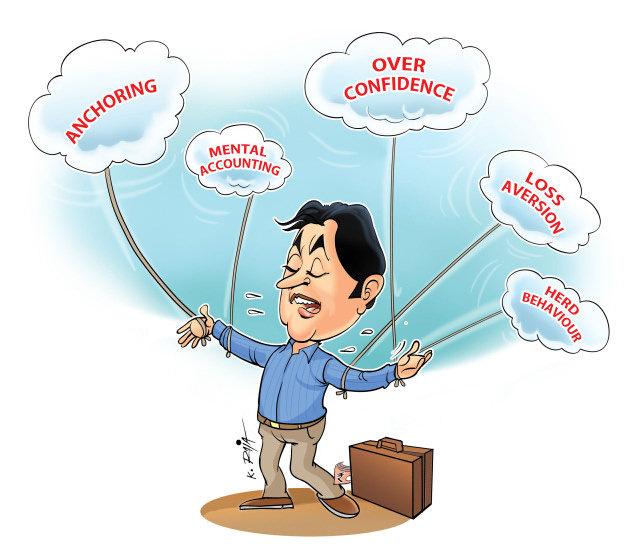
Today is the first day of Daylight Savings Time and we are adjusting to the loss of one hour.    I have come across a few articles recently about how the anchoring choice of a decision comes into play. The conversation of how we truly decide and move forward is always on-going.  Neuroscientists and Psychologists keep us busy reading their latest articles and the above picture shows another view of what goes on when we begin to make decisions.

Anchors Aweigh is a phrase used to release the weighted anchor holding a ship at the harbor.  Anchoring Decisions is a form of cognitive bias we all have which may be based on our education, culture, whether we grew up in a small or large family and the physical environment we enjoyed as children.  When we choose the first piece of information we hear about an event, we anchor on to itAlthough we may ask for some other information, we usually go back to the first piece of information we hear, because we unconsciously believe it to be true.

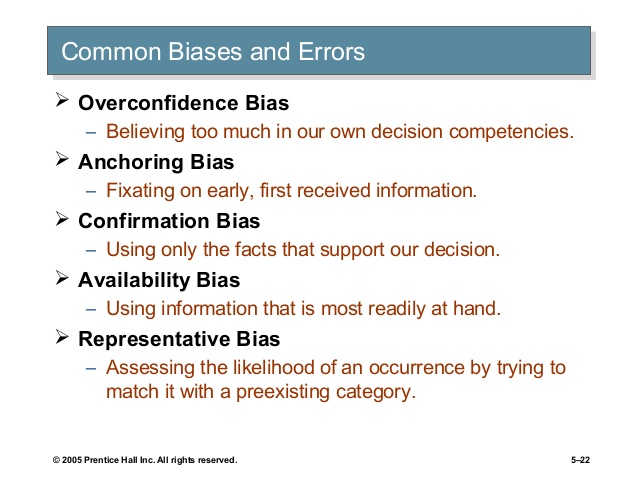
Perhaps some people haven’t considered how often they anchor what they hear.  Often times we wonder why someone may not move from a “position” and anchoring may be the reason.  Here is an additional view of how our unconscious bias influences our decision making.
c-05perception-and-individual-decision-making-22-638CommonDecisionBiasesGOOGLE030815


During this second week of March, 2015, consider how you Choose Who You Want to be Known As when reaching out to understand another person’s decision.  Have a great week!

“Jo Ann” M. Radja, Executive and Career Management Coach

http://www.wordpress.com/disclosures

Saint Nick – December 6th

Aside

thDEI6ULJ1BING120 614StNICK

Happy Saint Nicholas Day!  From the Third Century up to today, this day is celebrated throughout the world.  A wonderful explanation of St. Nick is provided under the heading beginning with Albania at this Wikipedia page:  http://en.wikipedia.org/wiki/St_Nicholas_Day

St. Nick’s kindness was extended to children, sailors and voyagers, during his lifetime.  Everyone of us is enveloped by that sense of kindness.  Be kind to someone during this holiday season to feel the goodness it brings back to you.

Enjoy.  “Jo Ann” M. Radja, Career Management Coach

http://www.wordpress.com/disclosures

http://creativecommons.org/licenses/by-nc-sa/2.0/


“‘Illusion of Trust’ as an Ethical Value”

Aside

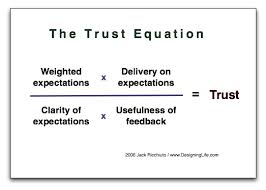
imagesWDEAZYJYWeightedTRUSTequationGoogle110514

When I was growing up, I often heard the phrase, “What does your gut tell you?”  or, “I’ve got a sick feeling in my stomach about this.” The phrase of listening to your gut has come into vogue again because neuroscience has recognized the gut communicates to the brain faster than your heart.  Why is this important to know as we just finished the Halloween and Election events?  Perhaps it is because trust is still an illusion.  We want it, we rely on it and when it is not present in our lives, it causes disharmony that we learn to live with or just accept it because “that’s the way it is.”

While we trust our guts to assist us as we get ready for the early Winter weather in the month of November, we can learn to trust our guts in other situations.  As you Choose Who You Want to be Known As this week, what positive value do you want people to know about you?  Have a great week.

Yesterday I published a Post on the social media platform of LinkedIn and I am sharing it with you below. (https://www.linkedin.com/pulse/article/20141105210316-32215190–illusion-of-trust-as-an-ethical-value?trk=prof-post)

“Illusion of Trust” as an Ethical Value  Nov 5 2014

The first way is: If you’re familiar with the 80/20 rule – speaking only 20% of the time in a relationship indicates it is dysfunctional. In other words, you give your own power of self-worth to another person.

The second way is: “Attraction creates the illusion of trust.” Fiffer recommends you listen to your gut when your judgment is being put aside for the other. When it comes down to it – why are you not paying attention to the feeling of, “something is not right here.”

Finally the third way appears to be derived from a social science or neuroscience perspective. Fiffer explains that when you are ruled by fear, you don’t act rationally and are unable to accept rational explanations. This appears to be so because the fear reaction, once triggered, will not stop until it is soothed.

As you manage your career, how often do you trust your gut in contract to your personal experience with an issue? How often has your gut enabled the right decision for you (or at least the best possible)? Do you keep an open mind first and then trust your gut, or the reverse? Interesting questions to consider during this first week in November.

I’m grateful I followed the linked and learned about The Good Men Project and hope to read Thomas G. Fiffer again. As you Choose Who You Want to be Known As, consider how often you trust and rely on your gut instincts to make informed decisions. Enjoy your month of November in your career.

“Jo Ann” M. Radja, Career Management Coach and Change Agent”

http://www.wordpress.com/disclosures

http://creativecommons.org/licenses/by-nc-sa/2.0/

Yes…You Can!

Gallery

This gallery contains 2 photos.

Change your Smile to Change the World.  Don’t let the World Change your Smile. @instamessageapp It’s prevalent in the workplace and in many facets of everyday life.  While we all agree it is sad and shouldn’t happen, there are experts … Continue reading

Tell or Ask…

Gallery

This gallery contains 1 photo.

Although it’s not Spring, our Building Management has asked us to consider disposing of unnecessary paper during a semi-annual shredding event.   I was surprised to uncover some Notes I kept from my position in Legal Management when I attended … Continue reading

When Culture Works Against a Customer

Aside

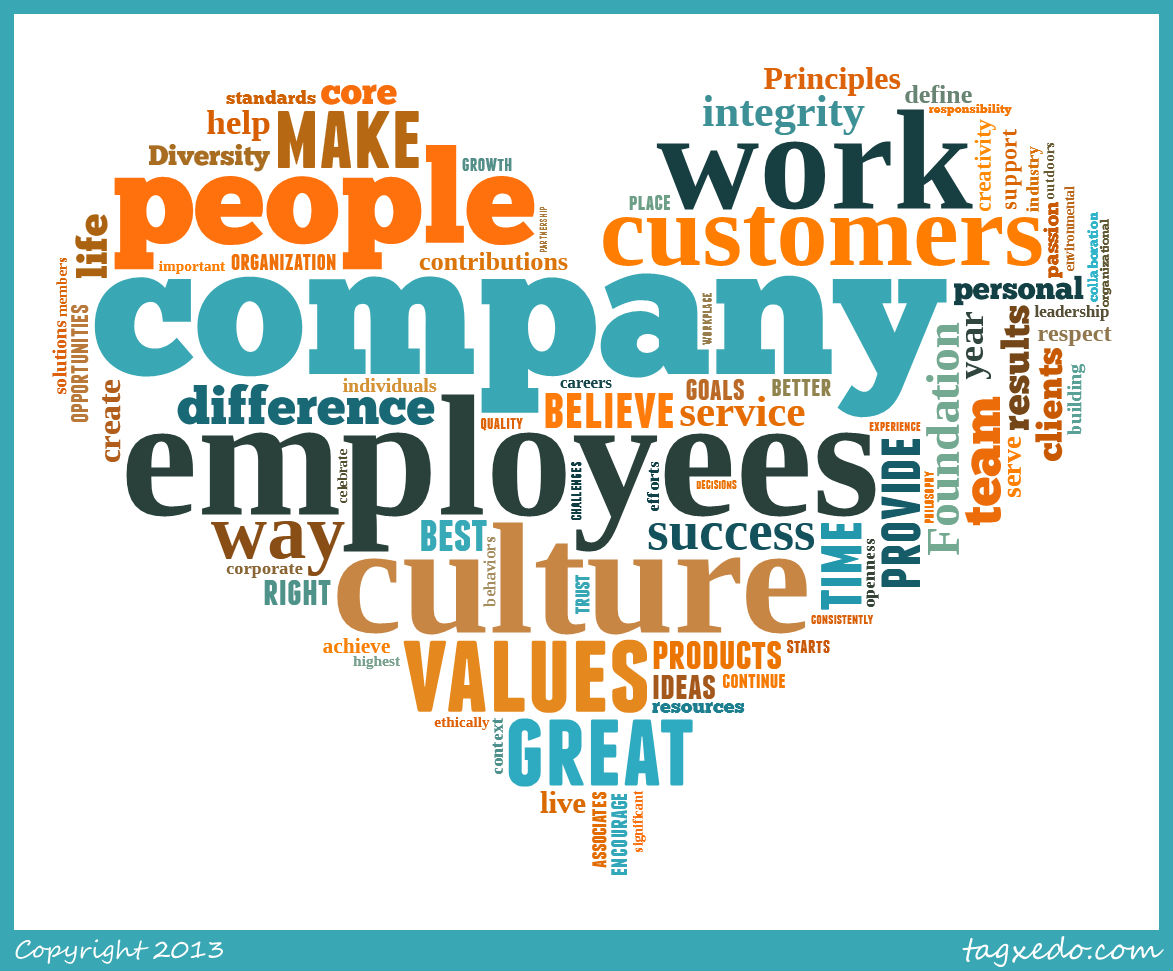
Culture-Word-CloudfromBING100214

There is a very humorous story of an employee who not only misplaced his cell phone once, but twice within the same day. True to form, he was able to continue his business trip.*  His story relates how he had the courage to recognize  – because of his own actions – his buttons were pushed and what he was capable of – it may be called:

Unresolved anger, rushing without focus, lack of self-management or a learning experience to depend on someone who is much younger than you are.

Yesterday on my way home, I stopped at the grocery store and found myself in a somewhat similar situation – a reversal of the above-story. The small electronic scanner, at the check-out counter failed.   After scanning my card, the screen did not link to the next page.   The moment I pressed the screen, it reverted to the welcome screen.  After at least five attempts, the Check-out Clerk announced, “She doesn’t know what she’s doing, call a Supervisor.”  She refused to hear how I explained the screen was malfunctioning.

The Supervisor arrived, attempted a fix, but the electronic scanner continued to fail. The Supervisor worked earnestly, while the Check-out Clerk mumbled for all to hear,  “She still doesn’t know what she’s doing.”   Finally, I asked if there was an ATM machine in the store.  I was told there was and had no trouble getting cash to pay for my groceries – which is what I attempted to do at the exit counter.  When I arrived back at the exit counter, both the Supervisor and the Bagger had their heads down in apology, while the Check-out Clerk, did not.  She only displayed an indignant face.

One definition of Culture in a workplace is, “It’s how we do things around here.”    I will probably visit this store again because there were other employees who had a friendly service attitude. Outbursts do occur, for a variety of reasons.   It’s How You Choose Who You Want to be Known As in the situation that matters to those around you and what you learned about yourself.   Have a great week in your career!

“Jo Ann” M. Radja, Career Management Coach and Change Agent

http://www.wordpress.com/disclosures

http://creativecommons.org/licenses/by-nc-sa/2.0/

* http://fortune.com/tag/stanley-bing .   “A Tale of Terror in which my true status in the universe is revealed to me.” September 22, 2014 print edition of Fortune Magazine.

“Is it form over function or function over form?”

contraforma-awkward-rockerGooglefreeimages082814


Here’s a Post which was published by LinkedIn.com within the past half-hour.:


“Have you ever been told, “That’s not what you are supposed to do.  That responsibility belongs to someone else.”  While you may have a Title for your position, it doesn’t necessarily explain what you actually do.  A Form usually relates to one thing and a Function relates to the activity of a specific Form.

The answer may lie in what binds the Function to the Form, whether by a job description, perceptions, testimonials or accomplishments.  As we begin to think about our upcoming Labor Day – how would you describe what you do – is it Form over Function or Function over Form? 

What do your customers expect from you. . . Function or Form? How often has it happened to you that you visit a retail store and what you wanted to buy is not sold by the Form name of the retail store?   Perhaps you contacted an Accounting firm, only to learn that the specialty service you want to hire is not found within the firm’s members?   Form over function sounds simple, but it isn’t.   

Another way of looking at form over function and function over form is to consider the word “feedback”.    Is feedback just a comment or response, or your understanding of what was said, or advice, or an opinion or a demonstration of your listening skills?  While you may have merely given encouragement to someone’s decision, it was received as advice, which was not your intention.   Perhaps this topic is another puzzle for us to work out in our careers because we live in a fluid, every-changing world.  

Consider as you Choose How You Want to be Known As, what is your answer to the Form or Function question.  Have a great day!” 

“Jo Ann” M. Radja, Career Management Coach and Change Agent

http://www.wordpress.com/disclosures

http://creativecommons.org/licenses/by-nc-sa/2.0/


Right now, at this moment, and no place else

Aside

ResilienceHefferBlogspotdotcomGoogle121713

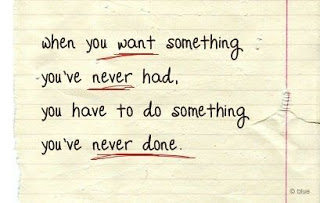
During your career, I’m sure you have realized it’s not easy to answer the question, “What do you want, right now, at this moment?”  Perhaps it’s because we don’t often get what we want or we don’t give ourselves permission to get what we want.  The reasons for this are so numerous; they would easily fill an unabridged dictionary.  So how would you answer the question, “Right now, at this moment, and no place else, what do you want?”

Perhaps there are actions available to you right now.  Are they reasonable, at this moment?  If the WANT is within your reach, what impact does not attaining your WANT have in your life right now?

A well-respected Neuroscientist, Dr. Jeffrey Schwartz, offers tips on “How to Reset Your Brain” as follows:


Change is Pain.     Behaviorism doesn’t work.

Humanism is over rated.  FOCUS is power.

Expectation shapes reality.

Start by leaving problems in the past.

Focus on identifying and creating new behaviors.

Self-insight creates change, not advices.


Dr. Schwartz explains that the reasons why goals weren’t met may be valid, i.e. the goals didn’t support or generate change.  So give yourself time to thinkWhen you do so, you generate new circuits of thought.  And with continued practice, new behaviors of change help you to achieve your WANTS.

Dr. Schwartz also tells us to remind ourselves to think regularly.  As you Choose Who You Want to be Known As this Summer weekend in July, consider whether this is an avenue that brings value to you.  Enjoy.


“Jo Ann” M. Radja, Career Management Coach and Change Agent

Notes:  AMEX OPEN FORUM, Strategy and Business Section, “The Neuroscience of Change, or How to Reset Your Brains.” Dr. Jeffrey Schwartz, University of California at Los Angeles School of Medicine. December 8, 2011.

http://www.wordpress.com/disclosures

http://creativecommons.org/licenses/by-nc-sa/2.0/

Belief, Believed, Believing…

Aside

valuesAndBeliefs.00Ning063014


A thousand words will not leave so deep an impression as one deed.  Henrik Ibsen


Recently, I heard a statement made by former President Bill Clinton that made me stop what I was doing because I chose to believe what he said.  (http://www.nbcnews.com/meet-the-press/meet-press-transcript-june-29-2014-n143826).  I was reminded how often we believe what we hear because it may make sense to us, yet it doesn’t meet the reality of facts.  What leads us to believe something is true or not?   Belief, Believed, Believing  may come into play with our answer.

We say, I can’t believe it” — when we hear good news about someone we know and we say, “I can’t believe it” when we hear very sad news about a tragedy.  On the other hand, we choose to believe our impressions of someone we just met, because we have a belief our judgment is correct.  Our birth and business cultures strongly influence us as to our Beliefs, what we Believed and are Believing.  Our experiences and schooling surely play out in our Beliefs as well.  As we are approaching the remembrance of the founding of our country in a few days, why do we believe so strongly in America and its values?

What we regard as true is a belief.  Frequently in our careers, we may be asked to describe what we do for a living and how we would describe what we do in a few words. We want our answers believed.

As we Choose Who We Want to be Known As – We Believe in ourselves and what we do.  Have a great Holiday Week!

“Jo Ann” M. Radja, Career Management Coach and Change Agent

Notes: http://www.nbcnews.com/meet-the-press/meet-press-transcript-june-29-2014-n143826.

The description of the word “belief”, Roget’s 21st Century Thesaurus, Third Edition Copyright © 2013 by the Philip Lief Group.

http://www.wordpress.com/disclosures

One Up, One Down and What’s You?

Aside

15352_20130513_133525_AgamGoogle061614

Dancing is just part of the discovery, discovery, discovery. Martha Graham


During your career, have you danced in the dance of   “One Up, One Down and What’s You?”  It’s been happening frequently in the Midwest this Spring.  The dance begins when you meet someone and you start a conversation.  The What’s You dance occurs when the sincerity of both people leads the dance and each person dances away from an engaging business conversation.
The One Up dance starts shortly after the conversation begins and one person keeps circling around the other, demonstrating a perceived betterment, for whatever reason.  This dance usually ends as each party has opposite views and a sense of connectedness was lacking in the dance.
The One Down dance takes more time.  Patience, Humility, Curiosity or Discovery of self,  or the other,  is flowing through the conversational dance.  Both people feel they have left the dance with a takeaway to be used or considered in the future.
While I just described three dances, I know you can name many others.  What type of career dance have you participated in this Spring?  What did you discover about yourself and has it helped you in your career?  What should have happened that didn’t?  What first step are you able to take, to move closer to the conversation dance that you want? 
Summer officially begins during the latter part of this week.  I hope this Summer Season in your career brings you closer to the dance where YOU Choose Who You Want to be Known As.  Have a great week!
“Jo Ann” M. Radja, Career Management Coach & Change Agent
Note:  http://www.wordpress/disclosures